British Shorthair Tear Stains: What's Normal, What's Not, and What to Do
British Shorthair tear stains explained: why breed anatomy causes runny eyes, when discharge signals infection, and what to do at home and at the vet.
The Worry
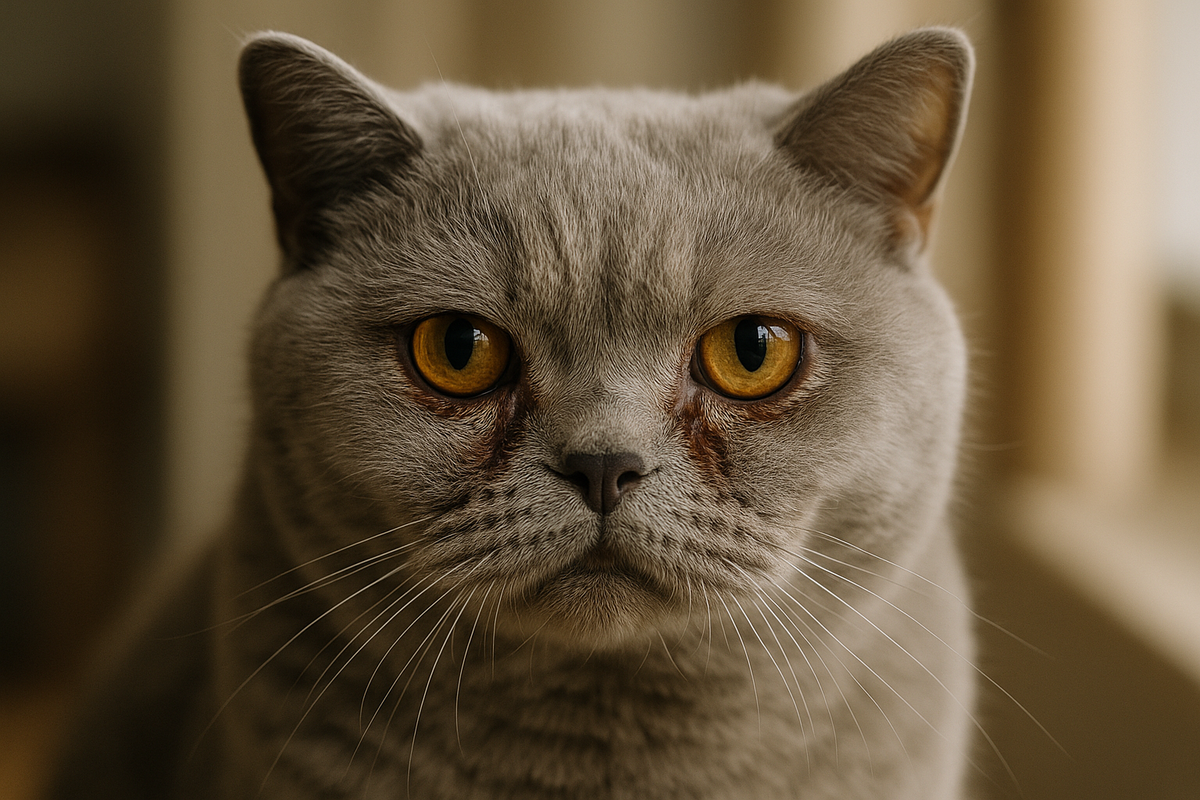
You notice it one morning — a reddish-brown streak below your British Shorthair's eye, standing out against their light-coloured fur. Your first thought is: did I miss something? Is something wrong? Maybe you've been checking different sources online, unsure whether this is just a British Shorthair thing or a sign your cat needs a vet. The worry is real, especially when you're attached to a cat who normally seems healthy.
Here is what you need to know: British Shorthair tear stains are extremely common in the breed, and for most cats, the cause is their facial shape — not illness, and not something you did wrong. But tear staining is not always harmless, and knowing the difference between normal tear overflow and a secondary infection is the most useful thing you can take away from this.
British Shorthair Tear Stains: What the Research Shows
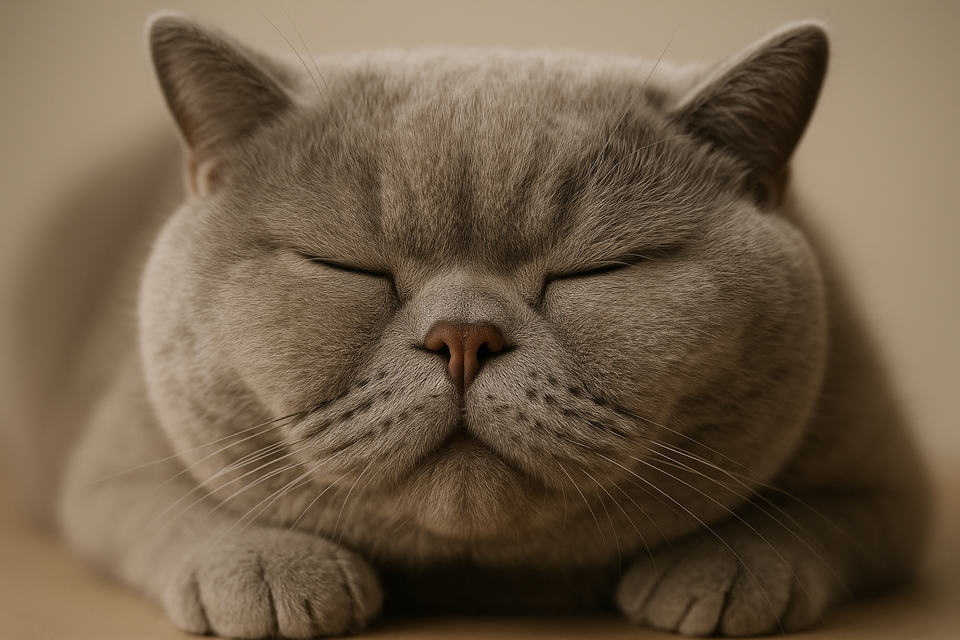
British Shorthairs have flat faces — the trait that makes them so distinctive, and one that shapes how their eyes drain. This is Brachycephalic Ocular Syndrome (BOS), and research shows it is the primary driver of visible tear staining in flat-faced cat breeds. A 2026 clinical study in the Canadian Journal of Veterinary Research examined 30 brachycephalic cats and found that altered eyelid positioning, reduced tear drainage, and changes to ocular surface anatomy — all direct consequences of the flat facial structure — cause tears to overflow onto the face rather than draining away normally.
This tear overflow has a clinical name: feline epiphora. It is not a flaw in your care. It is a predictable consequence of the anatomy that comes with the breed. The same anatomical pressures that affect brachycephalic breathing in British Shorthairs also act on the eye drainage system.
The same 2026 study found that bacterial conjunctivitis was the most common secondary diagnosis in brachycephalic cats presenting with eye discharge — recorded in 19 of 30 cats examined. Corneal ulceration was the next most common, appearing in 10 cats. That means what begins as breed-related tear overflow can develop into something more if bacterial growth takes hold in the damp fur and eye surface.
Here's why this happens so readily in flat-faced cats: A 2026 anatomical study published in the Journal of Veterinary Medical Science explains that cats have conjunctiva-associated lymphoid tissue (CALT) — immune cells that guard the eye surface — clustered heavily at the openings of the tear drainage system. This tissue is pro-inflammatory by nature, and its concentration at a point already under anatomical pressure in brachycephalic breeds creates a site where inflammation and infection are more likely to develop. In other words, a British Shorthair's eye anatomy is primed to fight infection, but that very readiness makes the eye more susceptible to becoming inflamed when bacteria do gain a foothold.
If tear overflow persists despite routine cleaning, and your vet has ruled out infection, the underlying cause may be a blocked nasolacrimal duct — the channel that normally drains tears from the eye toward the nose. A 2020 study in the Journal of Small Animal Practice found that a surgical procedure called canaliculorhinostomy — which creates a replacement drainage pathway using silicone tubing — achieved 100% procedural success in a small mixed-species case series. Long-term outcome data specific to cats remains limited, but the option exists when conservative management has not worked.
What This Means in Practice
Most British Shorthair tear staining is breed anatomy, not a problem to treat. Epiphora happens because the drainage system is compromised by the flat face — it cannot be cured by cleaning, and it does not mean your cat is sick. But the staining creates warm, damp conditions that bacterial or viral infection can exploit, which is why monitoring the discharge matters.
The distinction to hold in mind:
Normal tear overflow: Clear or lightly coloured discharge that dries as a reddish-brown or rust-coloured stain on light fur. The eye itself looks clear and comfortable. The cat is not squinting, pawing at their face, or avoiding light. The fur around the eye may be slightly wet.
Signs that warrant a vet visit: Thick, yellow, green, or unusually copious discharge. Visible redness or swelling at the inner corner of the eye or on the eyelid itself. Squinting, frequent blinking, or pawing at the face. Cloudiness on the surface of the eye. These are consistent with brachycephalic cat eye discharge caused by bacterial conjunctivitis, corneal ulceration, or duct obstruction — all of which require veterinary assessment, not home cleaning alone.
The difference matters in practice: if the discharge is clear and the eye itself looks bright and comfortable, you're likely managing breed-normal tear overflow well. If the colour shifts toward yellow or green, or if your cat's behaviour changes (more pawing, more squinting), that's when you call the vet. The early stages of infection can look subtle on a British Shorthair with naturally wet fur under the eye — which is exactly why monitoring what's normal for your individual cat is so useful.
The boundary matters because the two presentations look different but not dramatically so, especially in a cat with naturally damp fur under the eye. When in doubt, a vet check is the right call. Brachycephalic cats — much like British Shorthairs managing weight and associated health risks or dental problems — benefit from regular professional review precisely because their anatomy makes certain conditions harder to detect at a glance.
What to Do
-
Clean gently, daily. Use a soft cloth or cotton pad dampened with warm saline solution (or plain sterile water) to wipe the fur below the eye. This removes discharge before it crusts and dries, and it reduces the bacterial load on the damp fur. Work outward from the inner corner of the eye. Do not use commercial tear stain removers as a primary approach — these may lighten staining cosmetically but do not address the underlying cause, and some contain ingredients not suitable for use near the eye. Many owners find that incorporating this into a morning routine takes just one or two minutes once a habit is established.
-
Monitor discharge colour and consistency. Clear or amber, low-volume discharge that stains the fur = breed-normal, manage at home. Coloured, thick, increasing, or accompanied by eye redness or squinting = call your vet. Take a photo if you notice a change — it helps the vet compare against baseline.
-
Book an annual eye check. Ask your vet to include a Schirmer Tear Test (which measures tear production rate) and a fluorescein stain test (which checks for corneal ulcers) as part of routine health visits. These are standard ophthalmic tools that provide early warning of secondary complications in brachycephalic cats. The earlier a corneal ulcer or duct obstruction is caught, the more straightforward the management.
-
Escalate to a veterinary ophthalmologist when needed. If discharge persists despite cleaning, if your vet identifies a blocked nasolacrimal duct, or if corneal damage is found, ask for a referral to a veterinary ophthalmology specialist. Specialist-level assessment can determine whether surgical correction of the drainage pathway is appropriate — an option not routinely available at general practice but available when medical management has reached its limits.
What We Still Don't Know
Research on tear staining specifically in British Shorthairs is limited. Most studies group all brachycephalic cats together, so there is no published data quantifying how many BSH cats are affected relative to Persians, Exotic Shorthairs, or other flat-faced breeds. No longitudinal studies track whether tear staining changes with age in British Shorthairs — whether it worsens, stabilises, or improves over a cat's lifetime remains unknown. No controlled trials have compared different home-cleaning methods in reducing secondary infection risk. And no standardised veterinary guidelines exist for chronic epiphora management in BSH cats: how often to clean, which topical agents are safest, or which cats are most likely to need escalation to a specialist. The current evidence establishes clearly why tear staining happens and what the main risks are. The optimal management path, and how to tailor it to individual cats, remains largely a matter of clinical judgement.
Sources
-
Ozdemir E, Ozgermen BB. "Ocular disorders in brachycephalic cats and dogs: A clinical study from Türkiye." Canadian Journal of Veterinary Research. 2026 Jul 1;90(3):88-95. PMID: 42460135. https://pubmed.ncbi.nlm.nih.gov/42460135/
-
Wallin-Haakansson N, Berggren K. "Canaliculorhinostomy as a treatment for nasolacrimal duct obstruction in dogs and cats." Journal of Small Animal Practice. 2020 Jun;61(6):346-353. PMID: 32291775. https://pubmed.ncbi.nlm.nih.gov/32291775/
-
Hiraishi M, Namba T, Otani Y, Kira S, Ichii O. "Dominance of conjunctiva-associated lymphoid tissue in the feline ocular immune system, with identification of lacrimal duct-associated lymphoid tissue." Journal of Veterinary Medical Science. 2026 Jan 16;88(1):82-89. PMID: 41260699. https://pubmed.ncbi.nlm.nih.gov/41260699/
If you have concerns about your British Shorthair's health, consult your vet. This article is informational only.